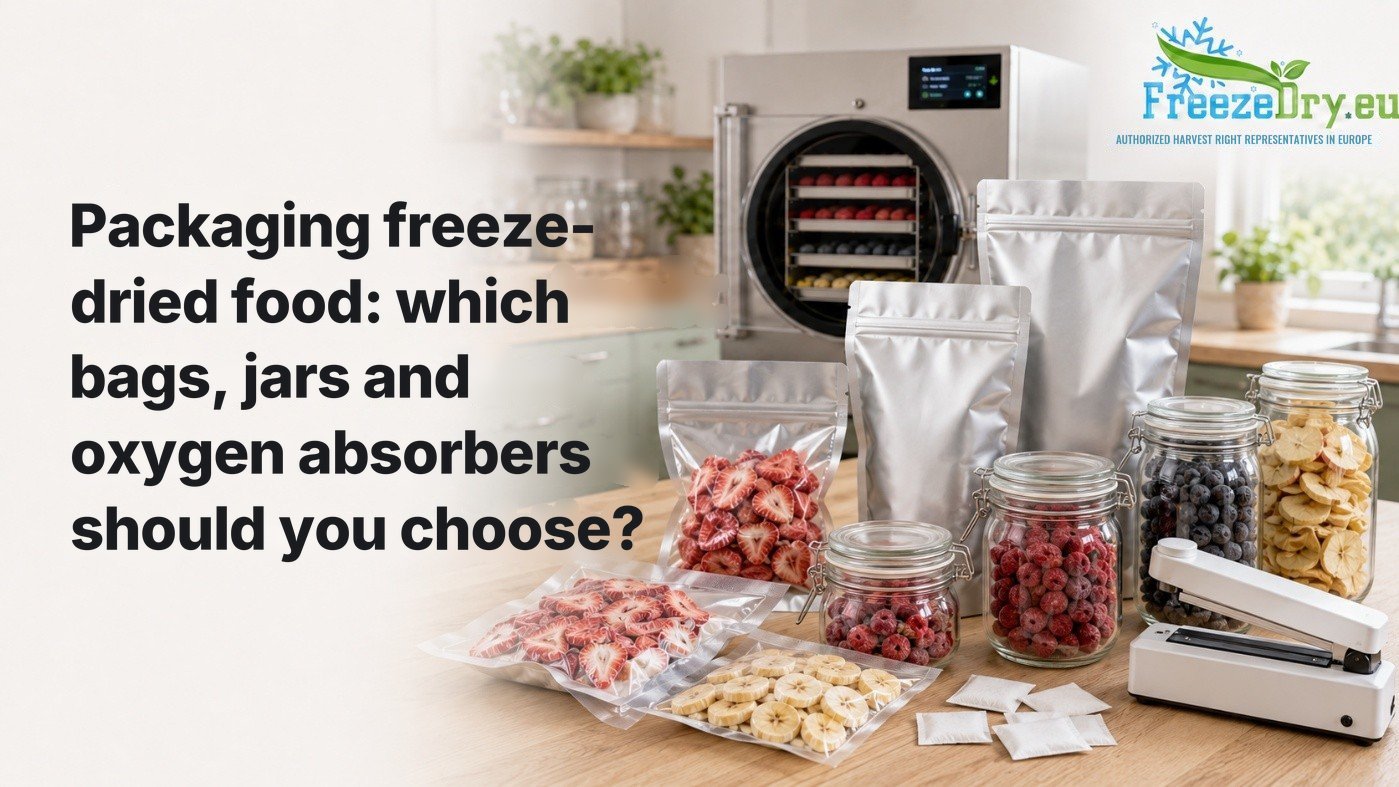
Proper packaging for a freeze-dried product is almost as important as the drying process itself. Even completely dry berries, fruits, vegetables, or prepared meals can quickly lose their crispness if the packaging allows environmental moisture to penetrate. Oxygen promotes fat oxidation and changes in flavor and color, while light can further accelerate the loss of quality.
There is no single type of packaging that is best for all products. The choice depends on how long the food will be stored and whether it is intended for family stockpiles, daily use, travel, or sale. The product itself is also important. Fragile raspberries need to be protected from being crushed, while a fattier meat dish needs to be protected from exposure to oxygen.
Choose packaging based on its intended use
For short-term storage and everyday use, an airtight jar or a high-quality resealable bag may be sufficient. Long-term storage requires packaging that reliably keeps out moisture, air, and light. For products intended for sale, it’s not just protective features that matter, but also easy-to-open packaging, the right size, clear labeling, and an attractive appearance.
| Type of packaging | Protection against moisture and oxygen | Who is it best suited for? | Major drawbacks |
| Multi-layer foil bag | Works very well if sealed properly | For long-term storage, travel, and retail | Requires sealing equipment; the product is not visible |
| Bag with a transparent window | Depends on the material of the window | For short-term storage and retail | Less protection from light |
| Vacuum bag | Good for short- and medium-term storage | For meat, vegetables, and prepared meals | Vacuum sealing may crush fragile items |
| Glass jar with an airtight lid | Very good if the lid is airtight | For everyday use and small batches | Does not protect from light; heavy and breakable |
| Plastic food container | Average, depending on the type of plastic and lid | For short-term storage and transport | Not all plastics are suitable for long-term storage |
| Food bucket with lid | Best used as external protection | Holds several sealed bags | One bucket alone often does not provide sufficient protection against oxygen |
Multi-layer foil bags
Thick, multi-layer bags with a foil barrier are most often chosen for long-term storage. They protect the product from light and significantly reduce the penetration of moisture and oxygen. The thickness of the bag is important not only for its permeability but also for its puncture resistance. The sharp edges of freeze-dried products can damage material that is too thin.
The bags with resealable strips are convenient for products intended for sale, but the resealable strip alone is not sufficient to ensure a long-term seal. A filled bag should be heat-sealed above the resealable section. The customer can then cut off the top, open the package, and temporarily reseal it later. A transparent window helps showcase the color of freeze-dried berries or fruit, but the packaging becomes more sensitive to light. In addition, it is important to consider the material from which the window itself is made. Visually appealing packaging is not necessarily the most suitable for long-term storage.
When should you choose glass jars?
Glass jars are convenient when you use freeze-dried products on a regular basis. They’re suitable for berries, fruit pieces, vegetable powders, spices, and other products that are often taken in small portions. The airtight lid protects against environmental moisture, and the jar itself does not crush the fragile contents.
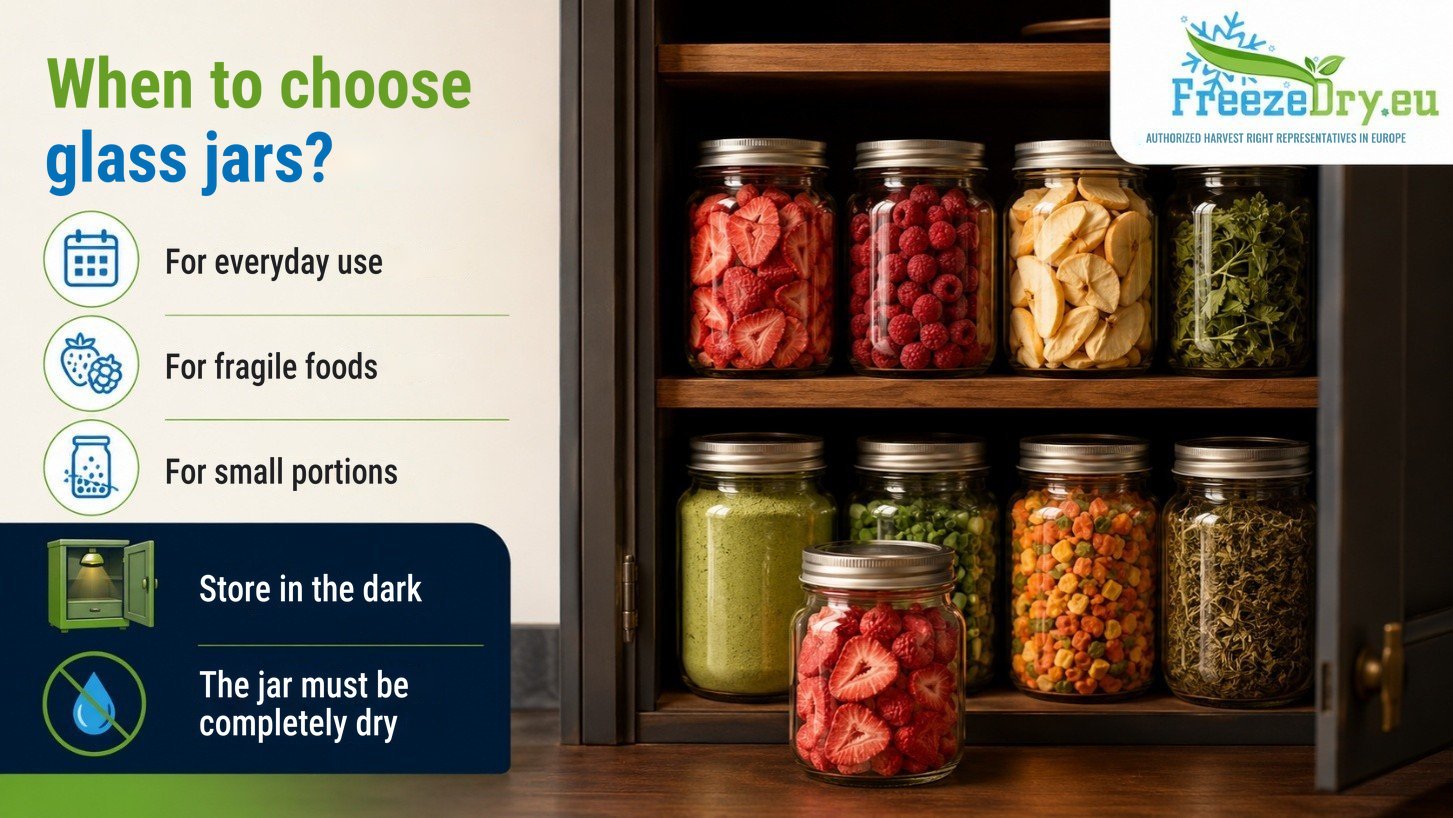
The main drawback of glass jars is that clear glass lets light through, so they should be stored in a closed cabinet or a dark pantry. For longer-term storage, you can choose tinted glass containers, but you must make sure their lids are truly airtight. Reusable glass jars must be thoroughly washed and completely dried. Even a few drops of water inside the jar can spoil the dry product. Lids should not be rusty, warped, or have absorbed the odor of a previous product.
Vacuum packaging isn’t suitable for everything
Vacuum sealing removes most of the air from the package and reduces its size. This method can be convenient for freeze-dried meat, vegetables, soup mixes, or ready-to-eat meals for travel. However, a strong vacuum can easily crush strawberries, raspberries, yogurt bites, and other fragile products. In such cases, you can use a rigid vacuum-sealable container or opt for a foil bag with an oxygen absorber. It’s important to remember that vacuum sealing and oxygen absorption aren’t exactly the same process—some air may still remain in the package after vacuum sealing.
How to choose an oxygen absorber?
Oxygen absorbers are labeled according to the amount of oxygen they can absorb, which is usually specified in cubic centimeters. The right size depends on more than just the bag’s capacity. You need to consider how much empty space will remain in the package and how much air will be between the pieces of the product. Light, porous berries can take up a lot of space, but there is also quite a bit of air between them. It is best to refer to the table provided by the manufacturer of the oxygen absorber and the packaging. An oxygen absorber that is too small may not remove enough oxygen, while one that is significantly too large usually just unnecessarily increases the cost of packaging.
The package of absorbents should be opened only after all the products have been weighed and poured into the bags. Once the absorbents have been added, the packages must be sealed immediately. Any unused packets must be placed immediately in an airtight jar or vacuum-sealed package. If left exposed to the air for a long time, they may lose their effectiveness.
An oxygen absorber should not be confused with a moisture absorber. One reduces the oxygen content, while the other absorbs moisture. Neither product can compensate for food that has not been dried sufficiently.
A tight seal matters more than attractive packaging
Before sealing the bag, wipe its edges clean. There must be no crumbs, powder, grease, or wrinkles between the layers being sealed. The sealing temperature is selected based on the bag’s material and thickness. The seam must be straight, continuous, and wide enough.
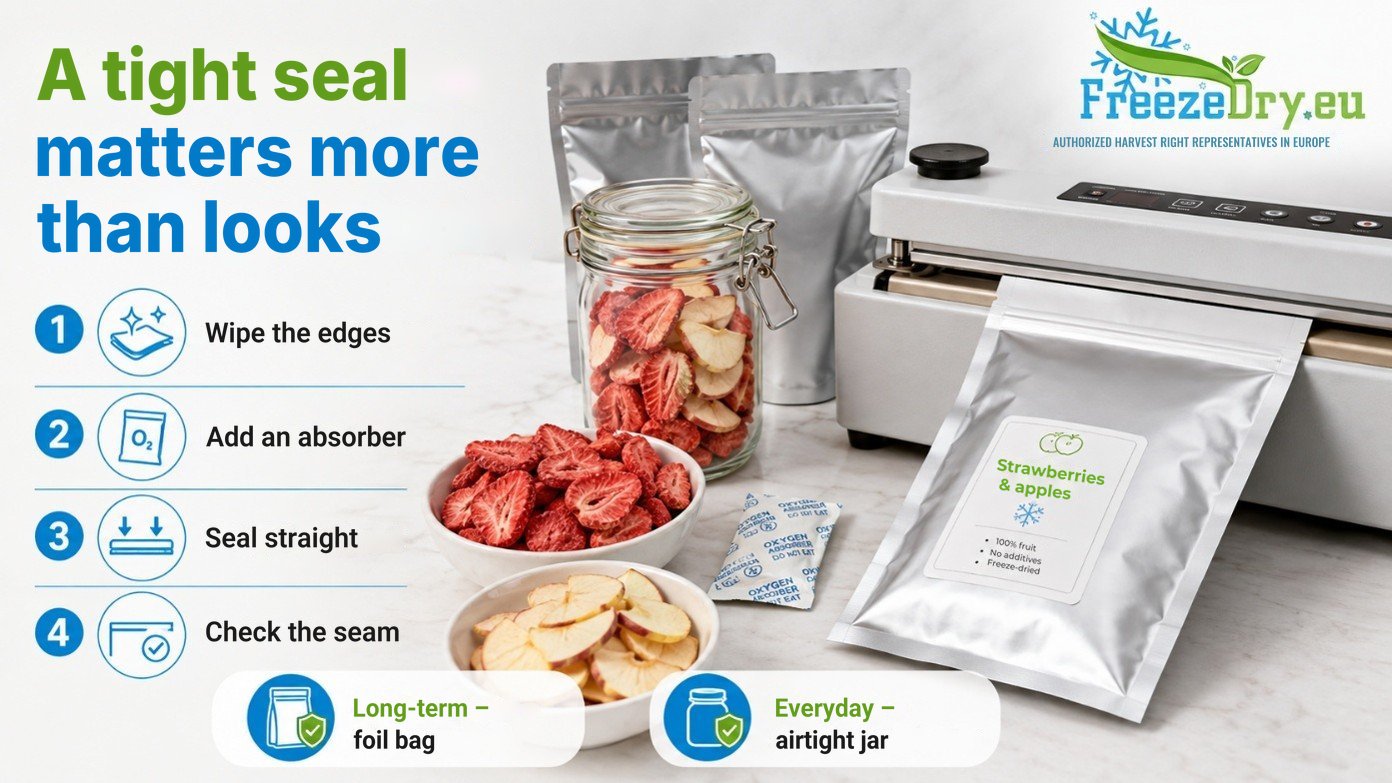
When selling products, it’s a good idea to conduct a trial packaging run and monitor the bags for several weeks to ensure they remain airtight and that the product stays crisp. It is also necessary to include space on the label for the product name, ingredients, net weight, packaging date, lot number, and other required information.


