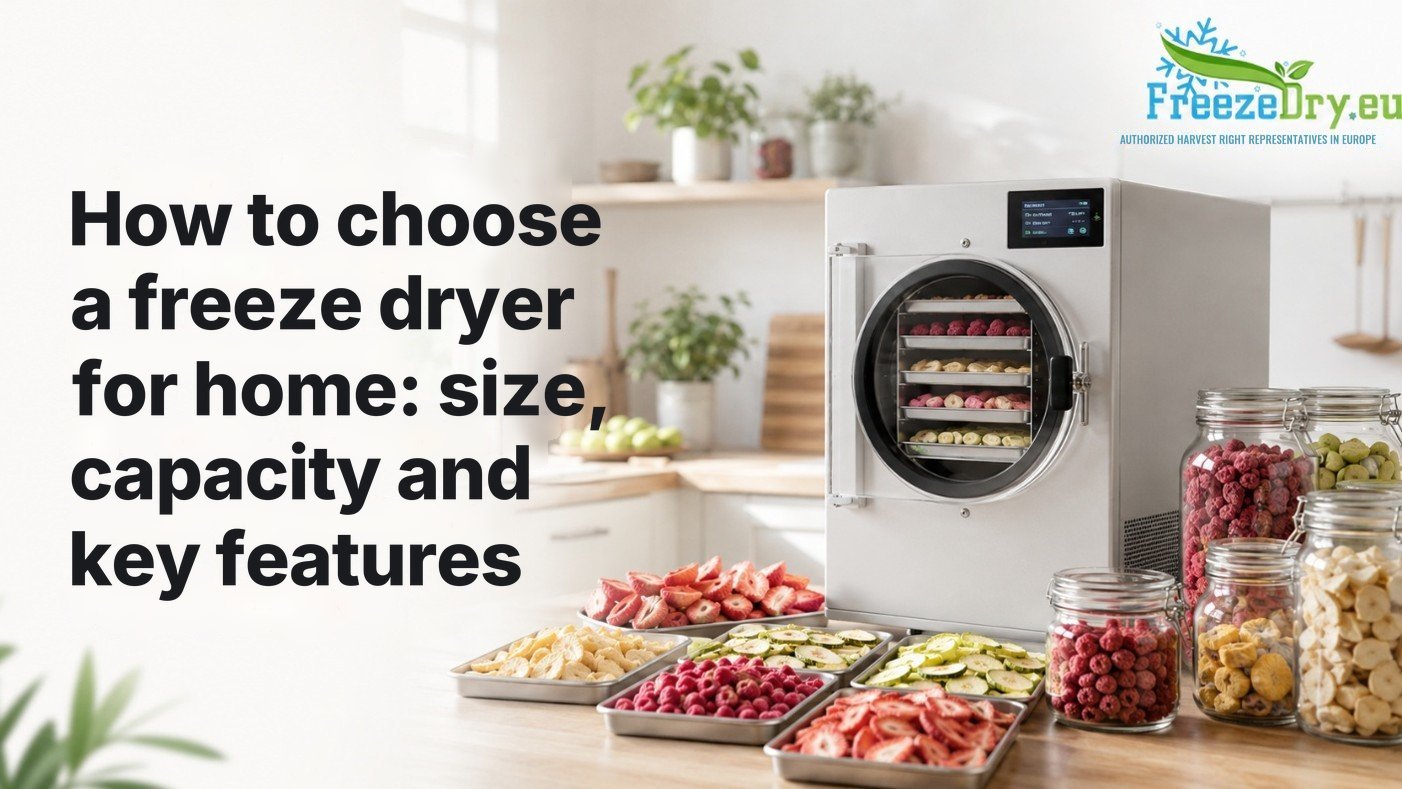
A freeze dryer is a long-term and significant investment, so it should not be chosen based solely on the lowest price or its external dimensions. A unit that’s too small can become a bottleneck during harvest season, while one that’s too large can take up a lot of space and end up being used only partially. Before purchasing, it’s worth assessing how much food you plan to freeze-dry, how often cycles will be run, and where all the equipment will be located.
It is important to consider more than just the freeze dryer itself. You will also need space for a vacuum pump, trays, packaging, a sealing machine, and the finished products. A larger capacity also means a larger quantity of fresh raw materials, which will need to be washed, cut and arranged before each cycle, and packaged afterwards.
Start by considering your needs
The first question shouldn’t be “Which model is best?” but rather “What will I freeze-dry, and in what quantities?” A single person who wants to make fruit snacks occasionally and a family that grows a large harvest of vegetables and berries need different equipment. You should consider whether the freeze dryer will be used to preserve seasonal harvests, prepare daily meals, pack for trips, create long-term food reserves, or support a small-scale commercial operation. It’s also important to consider how much space you have in your freezer. If you plan to freeze the products in advance, your freezer will need to accommodate the freeze dryer trays or containers of a suitable shape.
Estimate how much fresh food you could realistically prepare in a week. Just because you have a large garden doesn’t necessarily mean you need the largest appliance. If you can only devote a few hours a week to washing, cutting, and packaging food, you may not be able to make full use of a very large-capacity appliance.
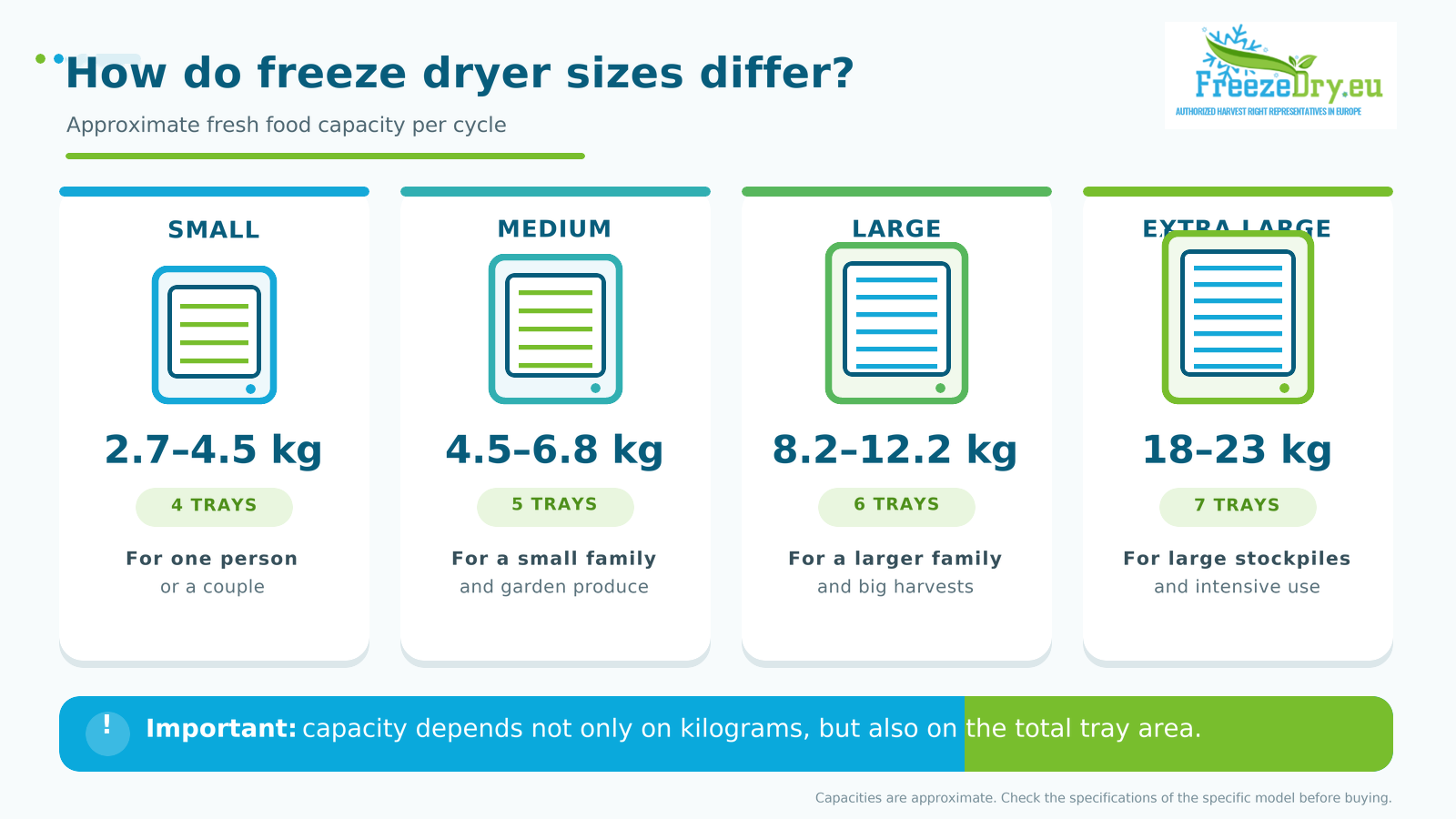
How do freeze dryer sizes differ?
Manufacturers typically specify capacity based on the weight of fresh food per batch, the number of trays, and their total surface area. The weight figure is approximate, since a kilogram of strawberries, a kilogram of soup, and a kilogram of meat will take up different amounts of space on the trays.
The table below is based on the capacities of the “Harvest Right” residential models currently listed by the manufacturer. Specific configurations and technical specifications are subject to change, so be sure to check the description of your chosen model before purchasing.
| Size | Approximate fresh food capacity per cycle | Number of trays | Who is it best suited for? |
| Small | About 2.7–4.5 kg | 4 | For one person, a couple, or occasional snacks |
| Medium | About 4.5–6.8 kg | 5 | For a small family, regular use, and garden produce |
| Large | About 8.2–12.2 kg | 6 | For a larger family, a bountiful harvest, or hunting or fishing catches |
| Extra large | About 18–23 kg | 7 | For very large inventories, intensive use, or activities approaching commercial scale |
A small model takes up less space and is easier to integrate into your home, but processing a larger batch will require more separate cycles. For many families, the medium-sized model may offer a good balance between capacity, size, and the amount of prep work required.
A large or extra-large model is only useful if its capacity will be filled regularly. You should assess whether your home has a suitable electrical connection, a sturdy foundation, enough space, and the ability to safely move the heavy unit. A very large household model can help a small business get started, but as volumes grow, you should consider commercial equipment and the requirements for food production.
Consider not only the kilograms, but also the tray area
The capacity of a freeze dryer depends on more than just the maximum weight. In most cases, tray space runs out first. Berries, mushrooms, apple slices, or candies are arranged in a single layer, so even a relatively light product can take up the entire tray. For soups, purees, and sauces, the depth of the tray is important, but you shouldn’t fill it all the way to the brim. A layer that’s too thick will freeze and dry longer. In this case, using multiple trays may be more practical than using a single very deep tray. Before choosing a model, it’s a good idea to visualize a typical batch you plan to freeze. For example, how many kilograms of strawberries do you grow, how many fit in a single layer, and over how many cycles would you like to process the entire harvest? This calculation is much more useful than an abstract promise of annual capacity.
Consider the overall dimensions of the equipment
The external dimensions of the freeze dryer do not reflect the total space required for it. There must be space in front to open the door and remove the trays. Airflow is required on the sides and at the back, and the ventilation openings must not be covered.
A separately installed vacuum pump also takes up space. It must be easily accessible for maintenance. Provision must be made for drainage hoses, electrical wiring, and a possible water collection tank.
Weight is also an important factor. The freeze dryer should be placed on a solid, level, and stable surface. When purchasing a larger model, it’s a good idea to plan ahead for how it will be brought through the door, lifted onto the table, and whether the chosen surface can support the weight of the equipment, the pump, and the full trays.
Choosing a vacuum pump
The vacuum pump is one of the most important components of the system. It determines whether the vacuum required for freeze-drying will be achieved in the chamber. When selecting equipment, it is essential to determine what type of pump is included in the package and what maintenance it will require. An oil-lubricated pump requires regular inspection, filtration, or oil changes. The condition of the oil can affect the vacuum and the stability of the entire cycle. An oil-free pump reduces some of the maintenance work, but its cost, noise level, and repair conditions may differ. You should consider not only convenience but also the availability of local service, spare parts, and technical support. The noise level of the pump is also important. If the freeze dryer will be located near living areas, it’s worth checking in advance not only the noise level of the unit itself but also that of the specific pump.
Which features are useful?
The most important features include automatic freeze and drying control, temperature and pressure monitoring, and the ability to add additional drying time. It’s convenient that the screen displays the cycle stage, provides alerts, and allows you to view key process data.
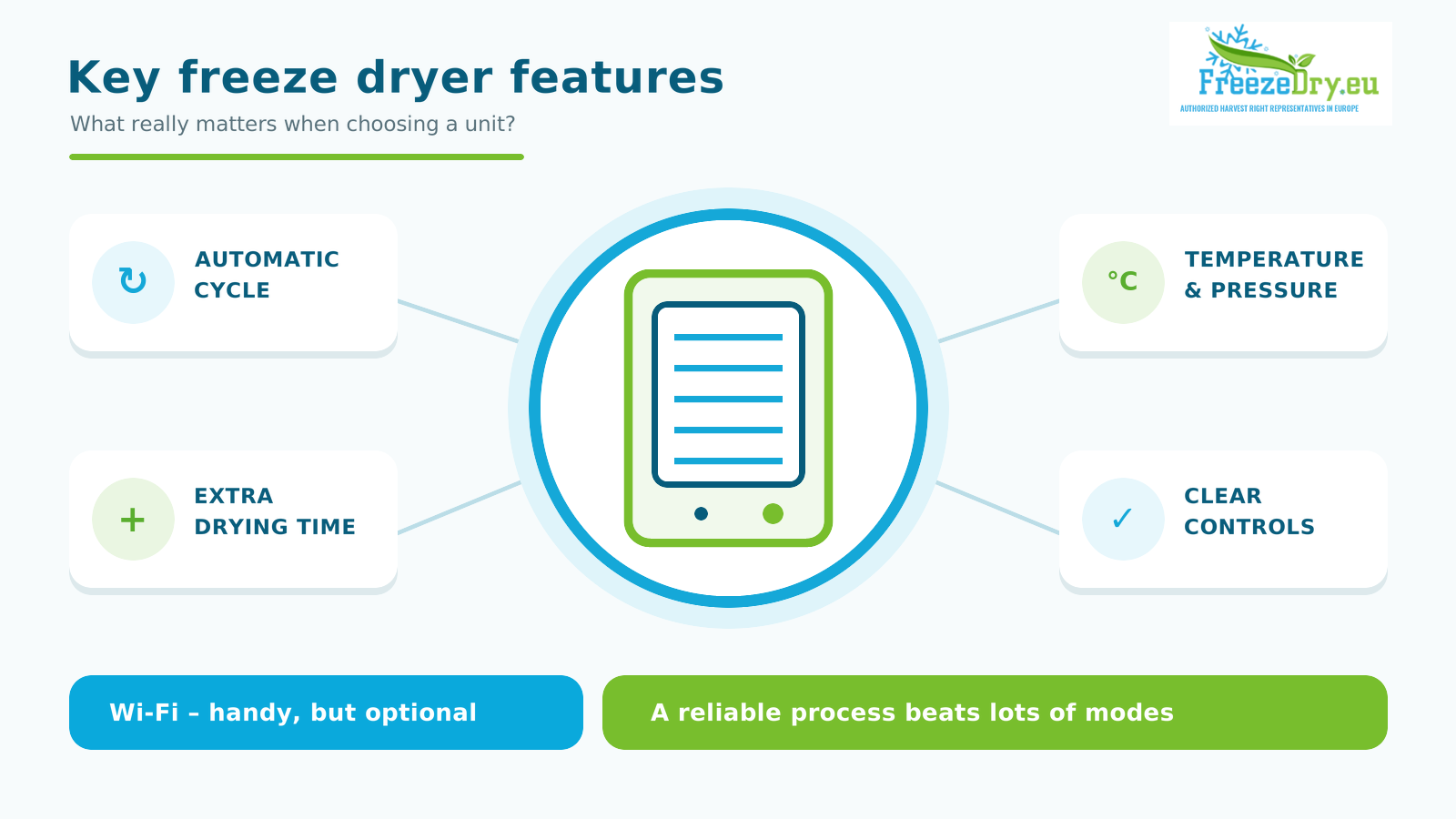
Different programs can be useful when preparing sweets, liquid dishes, or other specific products, but a large number of settings is not as important as reliable temperature sensors, a good vacuum, and easy-to-understand controls.
“Wi-Fi” connectivity and a mobile app make it more convenient to monitor the process or receive notifications, but these are additional features, not core functions. First and foremost, a freeze dryer must perform the freezing and dehydration processes effectively.
Check the electrical and space requirements
Before purchasing, be sure to check the voltage, power rating, and safety requirements specified by the manufacturer for the specific model intended for the European market. Larger models may require a separate electrical circuit. You should not rely on the specifications of a model intended for the U.S. market, as they may not be compatible with the Lithuanian electrical grid. The room must be well-ventilated and not too hot. In a warm environment, the freeze dryer takes longer to cool, which can prolong the cycle. You should also consider heat dissipation, noise levels, and the ability to safely drain defrost water.
The cost of equipment is not the only expense
The initial budget should include additional trays, lids for pre-freezing, silicone mats, bags, oxygen absorbers, a package sealing machine, vacuum pump maintenance supplies, and a possible electrical system upgrade. Operating costs are also important: electricity, packaging, pump maintenance, and wear-and-tear parts. If the equipment is purchased for business purposes, you should calculate the cost per batch, the realistic number of cycles that can be performed per month, and the time required to prepare and package the products.
The best freeze dryer isn’t necessarily the largest one. The most suitable one is the one whose capacity you can regularly utilize, for which you have a suitable location, and which you can maintain without difficulty. A small model may be perfectly sufficient for a smaller household, while a medium or large unit will be more practical for a family with a garden that plans to stock up on supplies regularly.


