
When planning your first freeze-drying trials , a practical question naturally arises: How long will you have to wait before the products can be removed from the machine and packaged? There is no one-size-fits-all answer, but a freeze-drying cycle typically lasts about 13–35 hours. Products with high moisture content, coarsely cut pieces, or dense textures may require even more time.
The cycle time depends not only on the selected product. It is also influenced by the size of the pieces, the overall load of the unit, the initial temperature of the food, the sugar and fat content, and even the temperature of the room where the freeze-dryer is operating.
Why does freeze-drying take longer than regular drying?
During freeze-drying, products aren’t simply heated until the water they contain evaporates. First, the food is deep-frozen. Then a vacuum is created inside the machine, and the ice formed in the product is gradually removed through sublimation— it turns from a solid into vapor without first becoming a liquid.
The process can be divided into three main stages:
- Freezing. The product must be completely frozen, including its thickest part.
- Primary drying. Most of the frozen moisture is removed from the product in a vacuum.
- Final drying. Any remaining moisture deep within the product’s structure is removed.
There’s no point in rushing the final stage. A piece that looks dry on the outside may still be moist on the inside, and packaging such a product would shorten its shelf life.
Estimated Lifespans of Different Products
The durations listed below are approximate. A modern freeze-dryer automatically controls the process and completes the cycle based on the actual condition of the products.
| Product Group | Estimated duration |
| Candy that requires special handling | about 2–4 hours |
| Berries and Juicy Fruits | about 20–35 hours |
| Chopped vegetables | about 15–30 hours |
| Boiled dishes and stews | about 20–40 hours |
| Meat and Meat Dishes | about 20–35 hours |
| Dairy products or eggs | about 20–35 hours |
For example, strawberries cut into thin slices will dry out faster than whole grapes. The skins of the latter prevent moisture from escaping, so it is recommended to cut them open or pierce them. Soup or sauce will also take longer to prepare than cooked vegetables cut into small cubes.
What usually causes a cycle to be longer?
One of the most common causes is a layer of products that is too thick. If the pieces vary greatly in size, the thinnest ones will dry first, but the machine will have to continue running until the moisture is removed from the thickest ones as well.
The process is also prolonged by:
- a very large amount of water;
- trays filled to the brim;
- products with different characteristics in a single batch;
- foods high in sugar or fat;
- warm, unfrozen products;
- The room temperature is too high, and ventilation is insufficient.
Fat is not removed during freeze-drying, so very fatty dishes may not only take longer to dry but may also be less suitable for long-term storage.
How can you shorten the cycle without compromising quality?
The simplest solution is to freeze the products in advance. You can store the prepared trays in the freezer and place them in the freeze-dryer only after they are completely frozen. This reduces the workload on the machine during the initial stage.
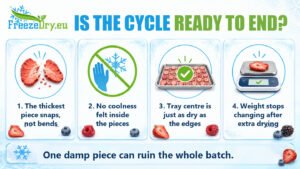
It’s best to cut the ingredients into uniform-sized pieces and arrange them in a single layer. Leaving a small gap between them helps the process proceed more evenly. It’s better not to pour liquid dishes all the way to the edges of the tray, and to spread very watery ingredients in a thinner layer.
A freeze-dryer also requires a suitable environment. Air must circulate freely around the unit, and the room should not become too hot. Regular maintenance of the vacuum pump and keeping the unit’s components clean help ensure stable operation.
How can you tell if the products are really dry?
At the end of the cycle, you should check the thickest piece, not the lightest one. When you break it open, the inside should be completely dry, brittle, and not cold. A cool, soft, or darker core may indicate that ice or moisture remains in the product. If in doubt, it’s best to allow for additional drying time. A few extra hours are usually a safer choice than packaging the product too early. It’s worth checking several pieces from different trays, as the temperature and drying rate inside the unit may vary slightly.
The End of the Cycle—But Not the Last Work
Dried products should be packaged IMMEDIATELY, as they quickly absorb moisture from the air. Airtight containers or jars, used in combination with oxygen absorbers, are suitable for long-term storage. It is helpful to label the package with the product name and the freeze-drying date.
If you want to plan your work more accurately, keep a record of the composition of each batch, the weight of the products, the thickness of the pieces, and the cycle time. After just a few trials, you’ll have your own practical chart tailored to the products you freeze-dry most often.


