The first freeze-drying cycle usually raises more questions than it inspires confidence. How should I cut the food? How much should I put on the tray? How can I tell if the food is completely dry? And what will happen if I put different fruits and vegetables in the same cycle?
It’s best to start with simple foods that have a fairly uniform texture, where changes are easy to notice. Fruits let you quickly sense how the flavor intensifies and the texture changes, while vegetables help you learn how to properly prepare food for longer storage. It’s best to save more complex, fatty, or high-sugar dishes for later experiments.
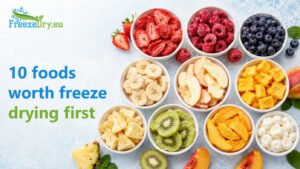
1. Apples – simple, crisp, and versatile
Apples are one of the most convenient choices for the first cycle. They’re inexpensive, easy to prepare, and the results are easy to evaluate. When properly freeze-dried, the slices become light and crispy, yet retain their distinct apple flavor.
Wash the apples, remove the cores, and cut them into slices of uniform thickness. It’s not necessary to peel them; the thin skin adds more texture. However, you can peel apples that have very thick or tough skin. To prevent the slices from browning, soak them briefly in water with a splash of lemon juice. Drain them before placing them on a tray.
Freeze-dried apples can be:
- to eat like chips;
- crush into a porridge or granola;
- for baking;
- grind into a powder;
- add to tea blends.
Tip for Beginners: Don’t cut the slices too thick. The more uniform the pieces are, the more evenly they will dry.
2. Strawberries—one of the tastiest early harvests
Freeze-dried strawberries are known for their intense aroma, natural sweetness, and crisp texture. They perfectly illustrate how freeze-drying differs from conventional drying: the strawberries don’t shrink into dark, rubbery pieces, but remain light and porous.
Wash the berries, remove the leaves, and dry them thoroughly. Cut large strawberries into 5–8 mm thick slices; smaller ones can be cut in half. Arrange them in a single layer on a tray, making sure there are no clumps of berries. Strawberries aren’t just for snacks. You can also grind them into a powder and use it to flavor creams, glazes, yogurt, pancake batter, or homemade chocolate.
Important: Even if the strawberries look dry on the outside, check the thickest part. When you break one in half, it shouldn’t feel cool or damp in the middle.
3. Bananas – a naturally sweet snack
Kids love bananas, and they don’t require any complicated preparation. Just peel them, cut them into slices of even thickness, and arrange them on a tray. Freeze-dried bananas become light and crispy, and their sweetness is more pronounced than that of fresh bananas. You can eat them on their own, mix them with nuts and other fruits, or grind them into a powder.
However, bananas contain quite a bit of natural sugar, so slices that are too thick may take longer to dry. It’s best to cut them into slices about 5–7 mm thick. Very overripe and soft bananas will be stickier, so for your first attempt, it’s better to choose ripe but still firm fruit.
Banana powder is suitable for:
- to sweeten porridge;
- for smoothies;
- for baked goods;
- for creams and desserts;
- for homemade snack bars.
4. Pineapples – a vibrant flavor with no added sugar
Freeze-dried pineapple is sweet, fragrant, and very crunchy. It’s a great choice for proving that a tasty snack doesn’t have to be candy. Peel the fresh pineapple, remove the hard core, and cut it into small, uniform pieces. You can also use canned pineapple, but be sure to drain it thoroughly. Fruit preserved in syrup may take longer to dry and remain slightly stickier due to the added sugar.
For your first attempt, pineapples preserved in their own juice or fresh pineapples work best. The pieces should not touch each other or be stacked in layers. They can be used as travel snacks, desserts, breakfast mixes, or chopped up and sprinkled on ice cream.
5. Frozen peas – almost no prep work required
If you want your first attempt at cooking vegetables to be as simple as possible, choose store-bought frozen peas. They’re already washed, briefly blanched, and frozen, so you can spread them out on a tray right away. Arrange the peas in a single layer. Small gaps aren’t necessary, but avoid thick clumps. After freeze-drying, they should be dry, light, and brittle.
You can use these peas to:
- add to instant soups;
- add to stews;
- grind into vegetable powder;
- use in purees or sauces;
- to take along on a trip as an unusual snack.
To rehydrate them, it’s usually enough to pour warm water over them or add them directly to boiling soup.
6. Corn – sweet and easy to use
Freezing sweet corn is also ideal for beginners. It’s easy to spread out on a tray, the kernels are all the same size, and it’s fairly easy to tell whether the process was successful. After freeze-drying, the corn becomes light and crispy. It can be eaten on its own or added to vegetable mixes, soups, stews, or Mexican-style dishes. If you’re using fresh corn cut straight from the cob, it’s recommended to blanch it before freeze-drying. For beginners, it’s easier to use pre-prepared frozen corn.
Tip: Peas, corn, and vegetables of similar size can be freeze-dried in a single cycle, since their structure and moisture content are quite similar.
7. Carrots – for soups, stews, and flour
Carrots are a practical choice for long-term food storage. When properly prepared, they retain their texture well and can be used almost the same way as fresh or frozen carrots. Wash, peel, and cut the carrots into small cubes or thin slices. It is recommended to briefly boil or blanch them before freeze-drying. This helps preserve their color and improves the final texture.
Freeze-dried carrots can be added directly to:
- soups;
- stews;
- rice dishes;
- mixed vegetables;
- sauces.
Grated carrots become a natural vegetable powder. They can be used to thicken soups, color pasta dough, or add to vegetable purees.
8. Yogurt – the first step toward more interesting snacks
Yogurt shows that a freeze dryer can be used to prepare more than just fruits and vegetables. It’s easiest to make small yogurt droplets or a thin layer that can later be broken into pieces. Place a silicone mat designed for this purpose or another base recommended by the manufacturer on the tray. Pipe the yogurt into small, uniform dots. You can use plain yogurt and flavor it with mashed berries. Yogurt that is higher in fat or contains a lot of sugar may take longer to dry. For your first attempt, it’s best to choose a medium-fat yogurt that isn’t too runny. Children especially love freeze-dried yogurt bites, but they must be stored in an airtight container—due to their porous structure, they quickly absorb moisture from the environment.
9. Cooked rice – a practical base for quick meals
Once you’ve got the hang of freeze-drying fruits and vegetables, you can try freeze-drying cooked rice. This is a good step toward creating well-rounded freeze-dried meals. Cook the rice as usual, but don’t leave it too wet. Let it cool, then spread it out in a thin layer. A very thick layer dries unevenly, so it’s best to spread the rice out over several trays. Freeze-dried rice is great for quick lunches, travel, and food storage. To rehydrate it, pour hot water over it and wait until the grains soften.
You can mix pre-cooked vegetables into the rice, but it’s worth trying it on its own first. That way, it will be easier to determine how much water is needed to restore its texture.
10. Thick soup or stew – the first course
Ready-to-eat meals are one of the most interesting applications of freeze-drying. You can preserve your favorite soup, stew, or other family dish and later rehydrate it simply by adding water. It’s best to start with a thick, low-fat soup or stew in which the ingredients are cut into small pieces. Very fatty sauces, large pieces of meat, and a thick layer of the product can pose challenges for a beginner.
Cook the dish thoroughly, let it cool, and only then distribute it onto the trays. The liquid mixture should not reach the edges of the tray. It is convenient to freeze the filled trays separately first and only then transfer them to the freezer. Before packaging, check the thickest part of the dish. It must be completely dry, crisp, and not cold.
The first cycle doesn’t have to be complicated
Getting started with freeze-drying will be much easier if you choose products whose preparation and results are easy to understand. Apples, strawberries, bananas, frozen peas, or corn are great for getting familiar with the machine, and later you can move on to rice, yogurt, and ready-to-eat meals.
The “FreezeDry.eu” team can help you choose a “Harvest Right” freeze dryer that meets your needs, explain how it works, and provide advice on its operation.
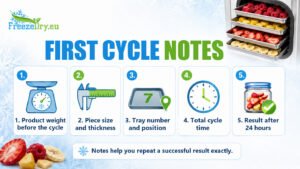
The most important thing is to start with a small, well-prepared batch, carefully evaluate the results, and note what worked best. After just a few rounds, you’ll feel more confident creating your own recipes, preparing food supplies for your family, or searching for new products for your business.


